If you're considering applying to IIM Ahmedabad's MBA-PGPX, you're probably asking one question:
"Do I realistically have a chance of getting into IIMA?"
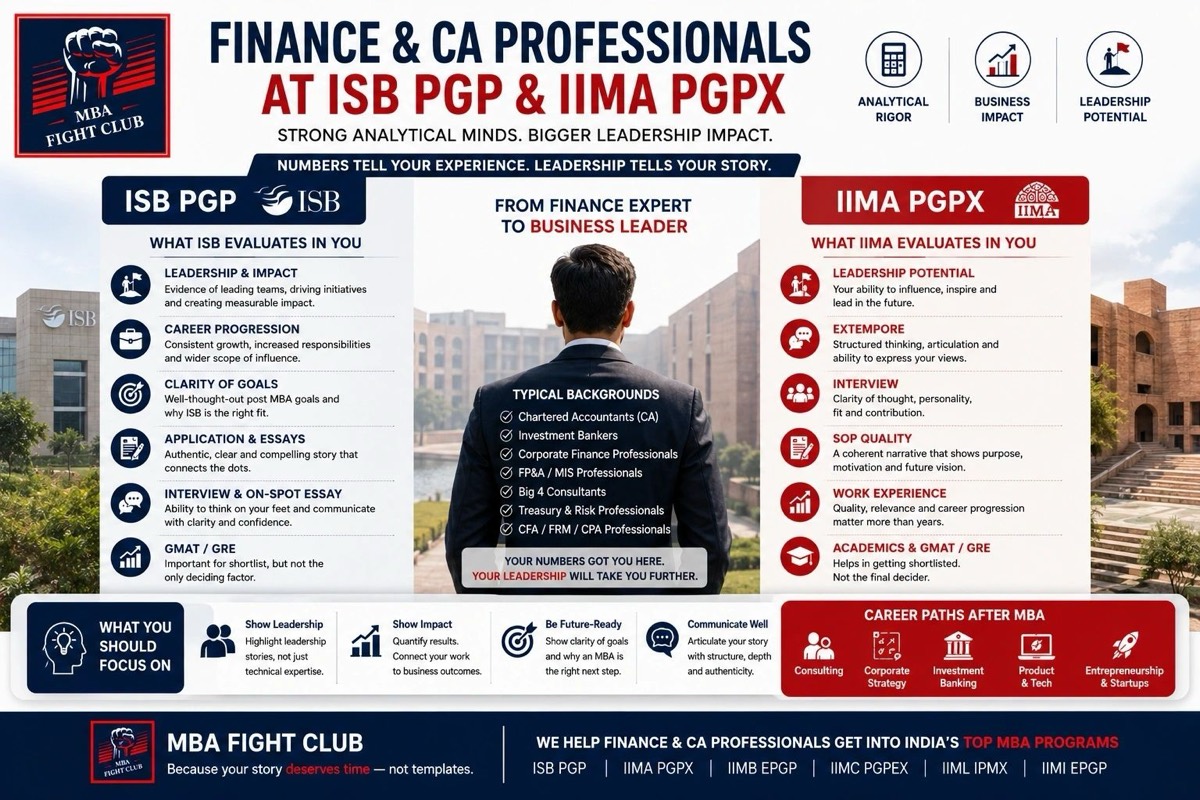
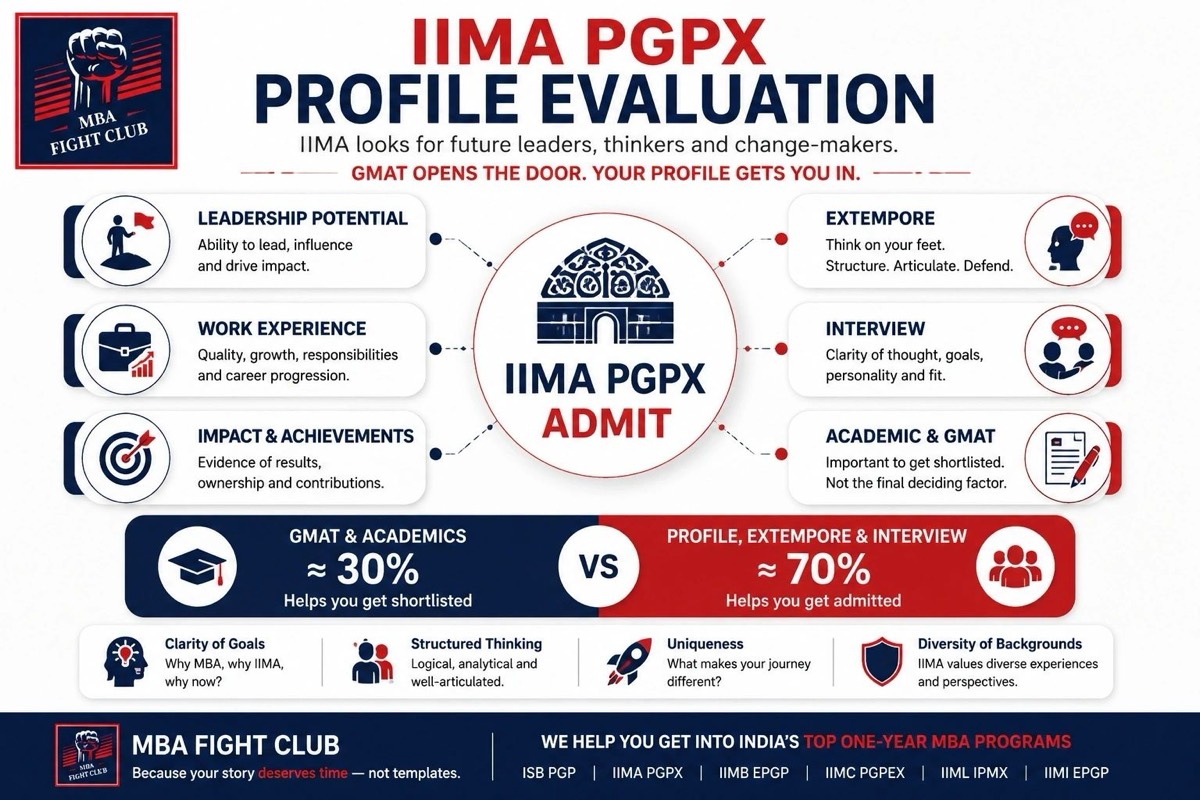
The answer is rarely determined by a GMAT score alone. In fact, among all one-year MBA programs in India, IIMA PGPX is perhaps the most interview and extempore-driven admission process.
Many applicants focus heavily on GMAT preparation while underestimating the importance of leadership, communication, structured thinking, and performance during the final evaluation.
This guide will help you understand:
✅ What IIMA really looks for
✅ What GMAT score is competitive
✅ How important the extempore and interview are
✅ What makes a strong or weak profile
✅ How different profiles are evaluated
Understanding the IIMA PGPX Admission Process
The official IIMA process consists of two stages:
Stage 1
Application review based on:
- GMAT/GRE score
- Academic profile
- Professional profile
- Leadership profile
Shortlisted candidates are then asked to submit essays.
Stage 2
Candidates undergo:
- Extempore
- Faculty Interview
The interview panel evaluates:
- Professional background
- Quality of work experience
- Career progression
- Leadership potential
- Accomplishments
- Academic preparedness
- Interpersonal skills
- Overall fit for the programme
IIMA explicitly states that selection is based on leadership profiling and personal interviews, not just test scores. (Indian Institute of Management Ahmedabad)
The Biggest Myth About IIMA PGPX
Most applicants believe: High GMAT = High Chance
Reality: High GMAT = Higher Probability of Interview Shortlist
After the shortlist stage, the game changes completely.
Historically, the majority of serious applicants who make it to interviews are academically capable.
The differentiator becomes:
- Extempore
- Interview
- Leadership potential
- Communication
Not GMAT.
The Most Important Component: Extempore + Interview
Unlike many other Indian one-year MBA programs, IIMA places enormous emphasis on how you perform on the interview day.
The process typically involves:
Extempore
You receive a topic.
You get limited preparation time.
You are expected to:
- Structure thoughts quickly
- Take a position
- Defend your viewpoint logically
- Handle questions calmly
The extempore is often a direct test of:
- Thinking under pressure
- Communication
- Leadership presence
- Conviction
Many candidates with strong profiles struggle here. Many average GMAT candidates outperform others because they communicate exceptionally well.
Faculty Interview
The interview is usually a stress interview. It is usually not conversational.
Faculty often explore:
- Your work experience
- Leadership examples
- Why MBA
- Why IIMA
- Career goals
- Industry understanding
More importantly, they are evaluating: How you think.
Not how much you know.
What GMAT Score Should You Target?
GMAT Focus 705+
Excellent score.
Provides strong shortlist chances. Still requires strong interview performance.
GMAT Focus 665–705
Competitive range.
Many successful admits come from this bracket. Strong leadership stories become critical.
GMAT Focus 635–665
Still very competitive for IIMA.
This surprises many candidates. Several successful admits every year come from this range because IIMA evaluates much more than test scores. Leadership and interview performance become decisive.
Below 635
Possible but increasingly difficult.
Requires:
- Exceptional leadership
- Strong career progression
- Unique profile
- Outstanding extempore/interview
What Makes a Strong IIMA PGPX Profile?
IIMA is fundamentally looking for future leaders. The strongest profiles generally demonstrate:
Leadership
Leadership is the single most important characteristic. Not designation. Not title.
Actual leadership.
Examples:
- Leading teams
- Managing crises
- Driving change
- Influencing stakeholders
- Taking ownership
Career Progression
IIMA likes growth.
Examples:
- Promotions
- Larger responsibilities
- Strategic projects
- Geographic expansion
- Team management
Impact
Strong profiles quantify outcomes.
Weak: Managed client engagements.
Strong: Led a transformation project that improved efficiency by 18%.
Structured Thinking
A highly underrated factor.
IIMA faculty love candidates who:
- Think logically
- Communicate clearly
- Structure responses well
This becomes highly visible during extempore and interviews.
Clarity of Thought
Strong candidates know:
- Why MBA
- Why now
- Why IIMA
- Why their target role
Weak candidates often sound generic.
Uniqueness
IIMA values diversity of thought.
Ask yourself: What makes my journey different?
The strongest profiles often have a spike:
- Entrepreneurship
- Defence
- Government
- Social impact
- International exposure
- Unusual career transitions
What Weakens an IIMA Profile?
Generic MBA Goals
Bad: "I want to become a leader."
Good: "I want to move from operational leadership into business transformation consulting."
Lack of Leadership Examples
Technical excellence alone is insufficient.
Poor Communication
Many high-GMAT candidates fail because they cannot articulate their thoughts clearly.
Weak Extempore Performance
Perhaps the single biggest reason otherwise strong candidates fail.
How Different Profiles Are Evaluated
Software Engineers
Most common applicant category.
Strengths:
- Strong academics
- Strong GMAT potential
Challenge:
- Differentiation
Must demonstrate leadership.
Consultants
Naturally aligned with PGPX.
Need:
- Strong impact stories
- Clear post-MBA goals
Product Managers
Highly attractive profiles.
Need:
- Strategic leadership examples
- Business impact
Entrepreneurs
Can be extremely strong.
Need:
- Business outcomes
- Learning orientation
- Scale of impact
Government & PSU Candidates
Historically successful at IIMA.
Need:
- Translate public-sector achievements into leadership stories
Armed Forces Candidates
One of the strongest profile categories at IIMA.
IIMA has historically shown strong openness toward defence candidates.
Why? Because they naturally bring:
- Leadership under uncertainty
- Team management
- Crisis handling
- Decision-making under pressure
All qualities valued in classroom discussions and future leadership roles.
Additionally, IIMA offers entry scholarships for defence personnel and several diversity categories. (Indian Institute of Management Ahmedabad)
Does Work Experience Matter?
Yes.
But not in the way most applicants think. Many candidates assume: More work experience = Better chances
Not necessarily.
IIMA explicitly admits candidates across a wide range of experience levels.
A candidate with:
- 4 years experience
can compete effectively with somebody having:
- 14 years experience
provided both demonstrate:
- Leadership
- Impact
- Growth
- Clarity
The question is not: How long have you worked?
The question is: What have you done with your experience?
Does Category Reservation Matter?
Yes.
IIMA follows the Government of India's reservation policy for:
- SC
- ST
- OBC
- EWS
- PwD
As a result, the level of competition can differ across categories.
Candidates should evaluate their chances within the context of the applicable category rather than purely based on overall applicant statistics. (Indian Institute of Management Ahmedabad)
A Simple IIMA PGPX Self-Evaluation Framework
Rate yourself from 1–5 in following categories.
- GMAT/GRE
- Leadership
- Career Progression
- Impact
- Communication
- Extempore Ability
- Clarity of Goals
- Uniqueness
Interpretation
32–40 → Strong Profile
24–31 → Competitive Profile
16–23 → Needs Better Positioning
Below 16 → Significant Improvement Needed
Final Thoughts
The biggest mistake applicants make with IIMA PGPX is treating it like a GMAT competition. It is not.
IIMA is fundamentally selecting:
- Leaders
- Thinkers
- Communicators
- Future change-makers
A strong score may help you enter the room. But once you're in the room: The extempore and interview often become the most important part of the process.
If there is one skill worth investing in after your GMAT, it is:
Structured communication under pressure.
That is exactly what IIMA evaluates.
Free IIMA PGPX Profile Evaluation
Wondering where you stand?
At MBA Fight Club, we help candidates evaluate:
✅ Shortlist probability
✅ GMAT competitiveness
✅ Leadership profile strength
✅ Extempore readiness
✅ Interview preparedness
✅ Career story and positioning
Over the last five years, we've helped candidates convert admits across IIMA, ISB, IIMB, IIMC, IIML, and IIMI, including candidates with GMAT scores significantly below class averages.
📲 WhatsApp 9725776404 for a detailed profile discussion.
Because your story deserves time — not templates.
Want this applied to your own profile?
Book a free 40-minute discussion with Abhinav. Talk through your score, experience and target programmes, and what your application needs. Only 10 applicants are taken each round.
Chat on WhatsApp See plans & fees