Choosing the right one-year MBA program requires more than understanding course content — it also demands clarity on the admission process and evaluation priorities of each school. While all these institutes look for leadership potential, clarity of goals, and academic excellence, the relative weightage of factors like GMAT/GRE scores, interviews, essays, and work experience varies significantly.
Below is a detailed comparison of what each B-school values most — and how to approach your preparation accordingly.
(This is based out of official website information, discussion with admissions team and alum information)
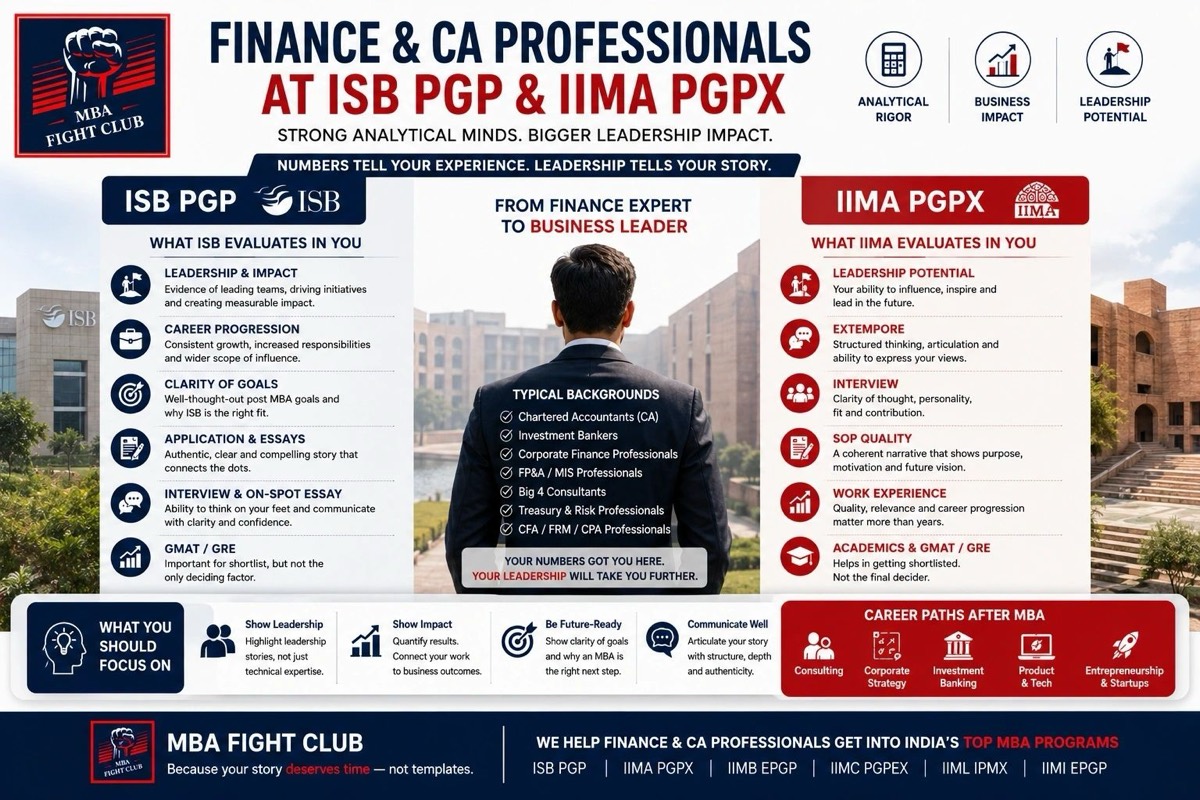
1. Indian School of Business (ISB)
Admission Process Overview
ISB’s admission model is based on holistic evaluation — not just your GMAT/GRE score. The process includes:
- Application (essays, work experience, academics)
- Interview (by alumni or admissions panel)
Weightage of Evaluation Factors
- Academics (Class 12–UG/PG) - 30%
- Test Score (GMAT/GRE) - 30%
- Interview Performance - 20%
- Work Experience (Quality & Quantity) - 20%
Key Takeaways
- Balanced profile matters — high test score alone won’t guarantee a call.
- Essays and work experience demonstrate leadership potential and fit.
- Candidates are also grouped into diversity and experience-based pools, ensuring a fair chance for non-traditional profiles.
- Interview is conversational but decisive; clarity on career goals is critical.
What’s Important: Consistent academics, impactful work profile, leadership stories, and crisp essays.
Less Important: Having only a high GMAT without contextual achievements.
2. IIM Ahmedabad (PGPX)
Admission Process
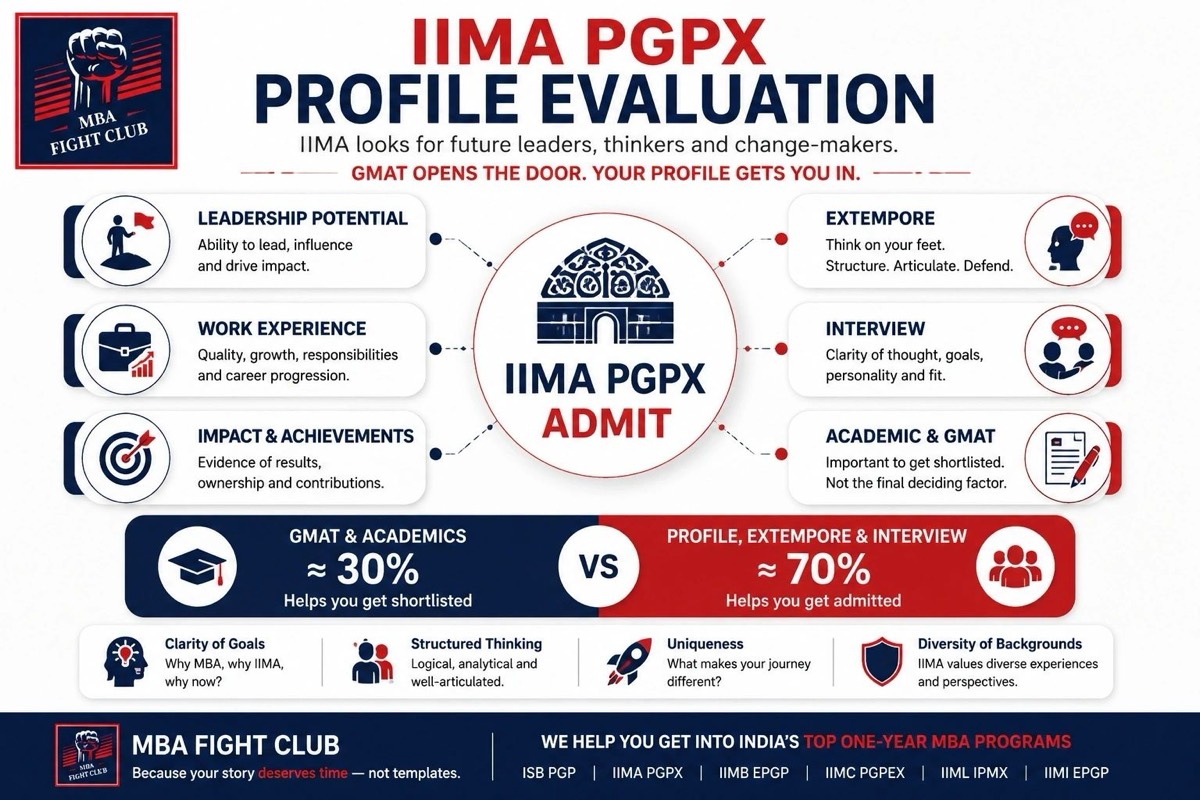
IIMA’s PGPX process is two-stage and rigorous.
- Stage 1: Shortlisting based on GMAT/GRE and leadership profile.
- Stage 2: Essay submission and personal interview with faculty.
Evaluation Parameters
- GMAT/GRE scores
- Essays (specific topics assigned post-shortlist)
- Professional trajectory and leadership potential
- Interview performance (fit, interpersonal skills, clarity of goals)
Key Takeaways
- Leadership experience and career progression are key.
- Extempore carry significant weight in selection — they test communication, clarity, and ability to critically think under pressure.
- The interview panel (faculty) looks for evidence of strategic thinking and maturity.
What’s Important: Leadership experience, essay depth, interview clarity.
Less Important: Overemphasis on technical achievements without a leadership context.
3. IIM Bangalore (EPGP)
Admission Process
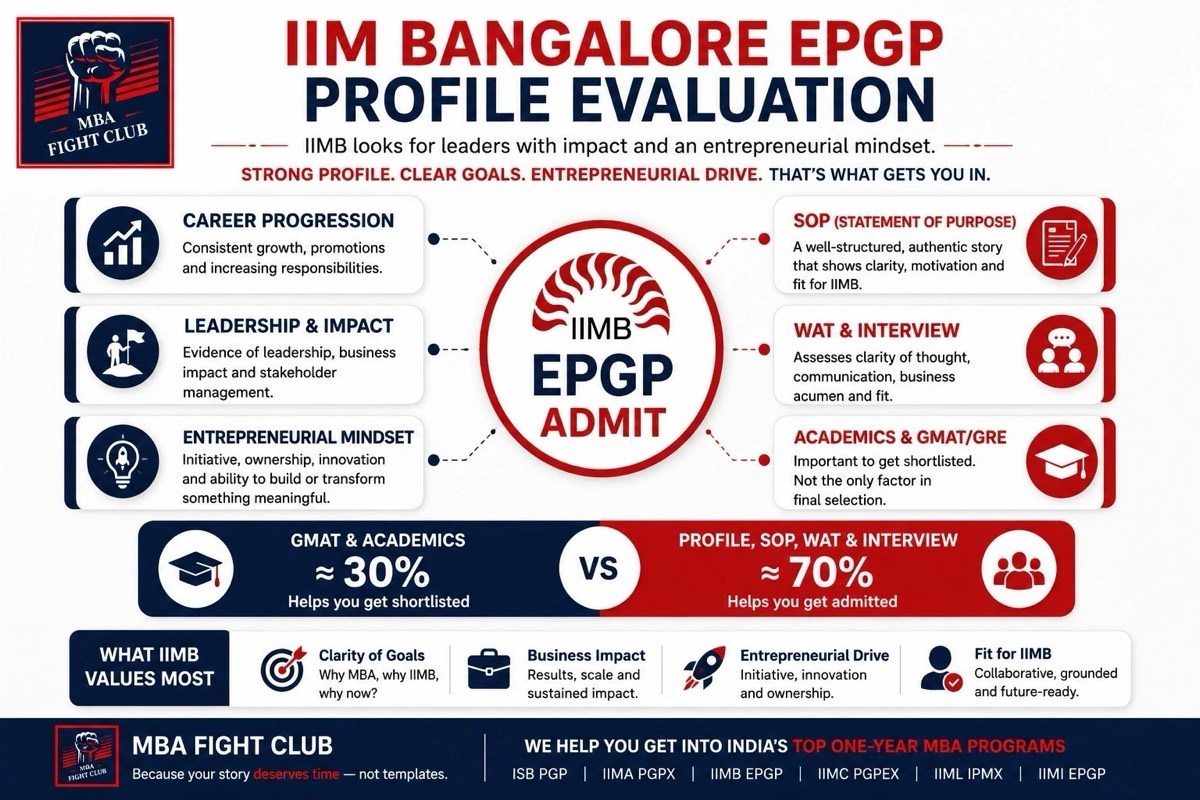
The IIMB EPGP process occurs in two stages:
- Stage 1: Online application, including SOP, GMAT/GRE, and documents.
- Stage 2: Composite score evaluation post-interview.
Evaluation Parameters
- GMAT/GRE scores
- Academic performance
- Quality of work experience
- Writing Ability Test (WAT)
- Personal Interview (PI)
Key Takeaways
- The Statement of Purpose (SOP) is critical — it’s the only extended essay in the form.
- Achievements and future goals form the core of evaluation (as per IIMB’s official website).
- Interview assesses career clarity, logical reasoning, and motivation.
- Candidates above 12 years of work experience are generally discouraged along with candidates with low scores in 12th and graduation.
What’s Important: SOP strength, test score, interview reasoning.
Less Important: Purely quantitative achievements with unclear career goals.
4. IIM Calcutta (MBAEX)
Admission Process
IIMC’s process is straightforward yet comprehensive:
- Application submission (including SOP and recommendations)
- Shortlisting based on GMAT and profile
- Personal interview (faculty-led)
Evaluation Parameters
- Academic background
- Professional experience
- GMAT score
- Statement of Purpose (SOP)
- Recommendations
- Personal Interview
Key Takeaways
- The SOP and recommendations play a huge role — both reflect credibility and motivation.
- The interview is analytical, often assessing how your experience links to post-MBA goals.
- No minimum GMAT cut-off; holistic assessment is applied.
What’s Important: SOP strength, recommendation quality, clarity of career vision.
Less Important: Extremely high GMAT without cohesive narrative.
5. IIM Lucknow (IPMX)
Admission Process
The IIML IPMX follows a transparent, weighted evaluation model.
- Shortlisting based on GMAT/GRE scores.
- Shortlisted candidates appear for a Writing Ability Test (WAT) and Personal Interview (PI).
- Final merit list based on composite score.
Weightage Breakdown
- GMAT/GRE - 30%
- Academic & Professional Profile - 30%
- Writing Ability Test (WAT) - 10%
- Personal Interview - 30%
Key Takeaways
- Both WAT and Interview together make up 40% of your selection score.
- The WAT tests your ability to organize ideas quickly and write on abstract or current topics (ethics, leadership, society).
- Interview explores domain knowledge, goals, and motivation for MBA.
What’s Important: Balanced performance across all parameters, clarity in essay and interview.
Less Important: Test score alone without strong WAT/PI performance.
6. IIM Indore (EPGP)
Admission Process
IIMI uses a composite score system with quantifiable weights.
- Shortlisting via GMAT/GRE/CAT and profile.
- Personal Interview (PI) round for shortlisted candidates.
Weightage Breakdown
- GMAT/GRE/CAT - 50%
- Personal Interview - 45%
- Diversity Factor - 5%
Key Takeaways
- Test scores and interview together dominate the selection (95%).
- The diversity factor encourages participation from non-traditional backgrounds (arts, humanities, women candidates, etc.).
- The interview focuses on professional growth, domain understanding, and personality.
What’s Important: Strong GMAT and confident interview.
Less Important: Overemphasis on essays — since IIMI does not have an SOP or WAT component.
Final Thoughts
Each top Indian one-year MBA program prioritizes a mix of academic excellence, clarity of purpose, and interpersonal presence.
In short:
"Numbers get you shortlisted. Clarity, composure, and storytelling get you selected."
Want this applied to your own profile?
Book a free 40-minute discussion with Abhinav. Talk through your score, experience and target programmes, and what your application needs. Only 10 applicants are taken each round.
Chat on WhatsApp See plans & fees