Insights from Amit Tyagi, Senior Associate Director of Admissions at ISB
Applying to the Indian School of Business (ISB) can feel like shooting in the dark for many candidates. Myths about “required GMAT scores” or “preferred profiles” abound, but few truly understand what ISB values. In a recent conversation, Amit Tyagi, Senior Associate Director of Admissions at ISB, demystified the entire process, sharing exactly how ISB evaluates candidates and what truly makes an application stand out.
This post distills that conversation into a clear, easy-to-follow guide.
1. ISB’s Holistic Admissions Philosophy
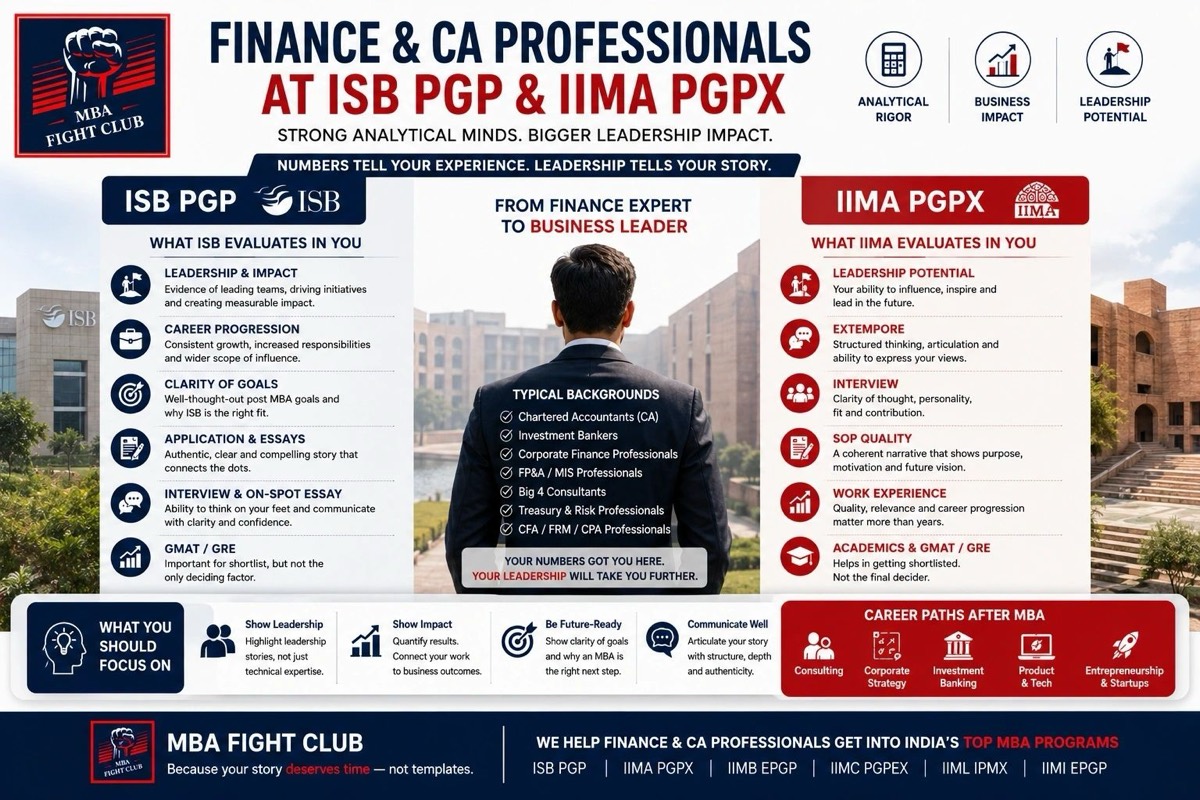
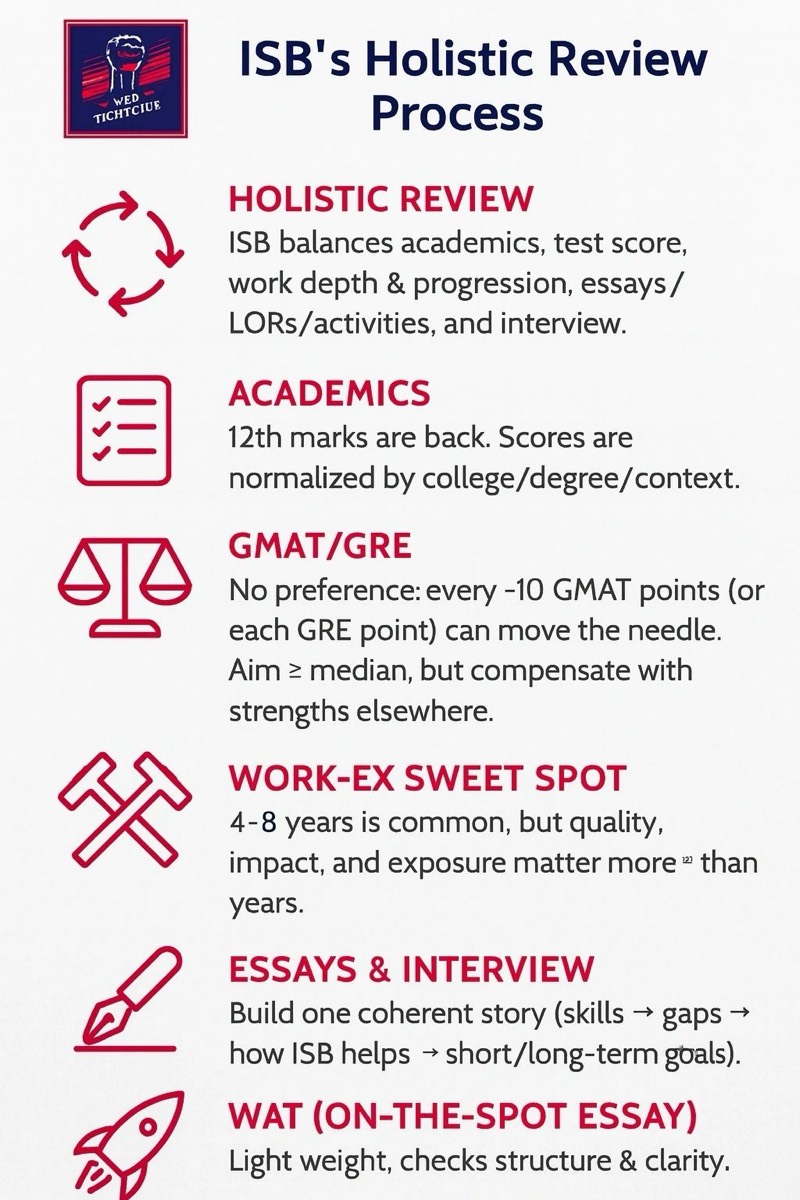
Every top global B-school has its own “ethos.” For ISB, holistic evaluation is at the heart of the process. The school doesn’t chase a type; it seeks well-rounded leaders, people who demonstrate:
- Leadership potential and initiative
- Problem-solving ability and critical thinking
- Entrepreneurial or innovative mindset
- Clarity of purpose and career vision
Unlike some international schools that emphasize global exposure or social impact, ISB’s focus is on diversity and leadership readiness across domains.
2. The Academic Section: More Than Just Grades
After a short hiatus, 12th-grade marks have made a comeback in ISB’s evaluation matrix. Tyagi clarified that ISB doesn’t simply judge academic scores, it normalizes them across universities, courses, and contexts.
“We understand that one bad semester or an illness can affect marks. We evaluate academics on a diversified scale—your undergrad degree, institution, and 12th-grade results all matter,” he shared.
So while grades count, they’re not absolute gatekeepers. ISB’s aim is to give everyone—whether from IIT or a state university—a fair shot.
3. GMAT & GRE: Every 10 Points Matter
Let’s bust a few myths:
- ISB does not prefer GMAT over GRE. Both are equally accepted.
- The median GMAT hovers around 675, and GRE around 328, but the range is wide—from 565 to 785 for GMAT and 306 to 338 for GRE.
- Every 10 points matter. There’s no fixed band like “below average” or “above average”—scores are mapped on a nuanced scale.
“Look beyond averages. Aim for your best possible score, but remember—your test score is just one part of your story,” Tyagi emphasized.
And for the record, placement recruiters do not see your GMAT/GRE scores. So stop stressing about whether your 650 is “too low.”
4. Work Experience: The Sweet Spot and What Matters More
ISB typically prefers candidates with 4–8 years of work experience, though students with fewer or more years also get admitted. What matters is not how long you’ve worked, but how you’ve grown.
ISB evaluates your experience through:
- Progression: Promotions, expanding roles, and responsibilities
- Exposure: Type of projects, cross-functional or international work
- Impact: Quantifiable results or skills gained
“It’s not about designations or brand names. A startup generalist can be as valuable as an Amazon program manager,” Tyagi noted.
The evaluation here is nuanced—reviewers are senior members who assess context and contribution, not just resumes.
5. Essays, Recommendations & Activities: Your Story Canvas
ISB’s essays and recommendation letters are where your story comes alive. They aren’t separate from the interview—they feed into it.
“The application is your canvas. Don’t just fill forms—paint your narrative,” Tyagi advised.
Here’s what ISB looks for:
- Self-awareness: Do you understand your skills, strengths, and weaknesses?
- Clarity of purpose: Have you analyzed what skills you have, what you lack, and how ISB bridges that gap?
- Logical goals: Are your short- and long-term goals consistent with your background and the ISB experience?
Although ISB has removed the “post-MBA goals” essay, candidates are still expected to articulate those goals in the interview.
6. The Interview: It’s Not About Perfection, It’s About Clarity
The ISB interview is not an interrogation—it’s a conversation led by alumni who understand real-world challenges. To ensure fairness, ISB trains its panelists and pairs them based on industry relevance and diversity.
What matters most:
- Authenticity. Rehearsed answers are easy to spot.
- Depth. Expect “one mile deep” probing into your answers.
- Coherence. Your essays, resume, and responses must align.
ISB also introduced a Written Assessment Test (WAT) before interviews—a short on-the-spot essay. Its weightage is small but helps gauge your ability to think and write clearly under pressure.
7. Scholarships, Rounds & Reapplications
Scholarships
Both merit-based and need-based scholarships exist. A high GMAT doesn’t guarantee aid—your overall profile, interview performance, and diversity value matter more.
Rounds
Apply when your application is ready. Round 1 isn’t inherently “better,” though it helps if you’re seeking scholarships or have long notice periods.
Reapplications
No stigma here. ISB treats reapplicants as fresh candidates. In fact, they often perform better because they’ve learned from past feedback and have a clearer narrative.
8. Special Cases: Family Business, Career Breaks & Entrepreneurs
- Family business candidates: Must show proof of income and a clear understanding of their business’ macro and micro aspects.
- Career breaks: Perfectly fine—just explain the reason and what you learned during the gap.
- Entrepreneurs: Highly valued. ISB even offers incubation through I-Ventures, with the option to return to placements after a year if your startup doesn’t take off.
9. Diversity & Inclusion: Beyond Numbers
ISB’s 2024 batch had 47% women, almost gender parity—not due to quotas but because more strong applications came in. Similarly, the engineer-to-non-engineer ratio naturally fluctuates each year.
“We are a merit-based school. If 70% women qualify on merit, so be it,” Tyagi said firmly.
10. The ISB Mindset: What Sets Successful Applicants Apart
To wrap up, Tyagi highlighted what differentiates admits from near-misses:
- Self-awareness: Knowing who you are and what you want
- Logic and coherence: Connecting your past, present, and future
- Authenticity: Owning your story without exaggeration
- Preparation: Applications that feel deliberate, not rushed
“The application is not just a form—it’s a reflection of your clarity,” he concluded.
Final Takeaway: Approach ISB Like a Strategy Project
Think of your ISB application as a consulting case on yourself:
- Define your problem (Why MBA? Why now?)
- Analyze your current state (skills, gaps, achievements)
- Propose a solution (How ISB fits into your journey)
- Show results (what impact you’ll create next)
Do that well, and you won’t just get into ISB—you’ll already be thinking like the kind of leader ISB wants to nurture.
Frequently Asked Questions (ISB Admissions)
Q1. Does ISB prefer GMAT over GRE?
No. ISB is test-agnostic. Choose the exam that maximizes your score.
Q2. Is a 650 good enough?
It can be—if other strengths (work impact, essays, interview) are strong. Every 10 points help.
Q3. I have a career break. Is that a problem?
No. Be honest about why, what you learned, and how you’re ready now.
Q4. I’m from a family business. How do I present it?
Show income proof, responsibility scope, and business understanding (macro/micro). Impact > title.
Q5. Are reapplicants at a disadvantage?
No. They’re treated as fresh applicants—and often convert with a clearer story.
Q6. What is the WAT and how important is it?
A brief on-the-spot essay before interviews. Light weight, focuses on logic/structure.
Source & Attribution
This guide distills insights shared by Mr. Amit Tyagi, Senior Associate Director of Admissions at ISB in publicly accessible forums, combined with best practices from successful applicants and interview panels.
Want this applied to your own profile?
Book a free 40-minute discussion with Abhinav. Talk through your score, experience and target programmes, and what your application needs. Only 10 applicants are taken each round.
Chat on WhatsApp See plans & fees