Getting shortlisted for the IIMA PGPX interview is only the first step. The essays are where IIMA gets to understand the person behind the GMAT/GRE score, designation and years of experience.
IIMA does not publish its PGPX essay topics in advance. Only shortlisted candidates write the essays, on topics given with a short submission window. The topics below are from the 2026–27 (previous) cycle: three essays (400, 400 and 200 words) plus a 400-word reapplicant essay. This cycle's topics may differ, but the approach below applies to any IIMA essay. Round 2 closes on 23 November 2026 (as reported; check IIMA's admissions page).
With these word limits, the challenge is not finding enough to write. It is deciding what deserves space and what does not.
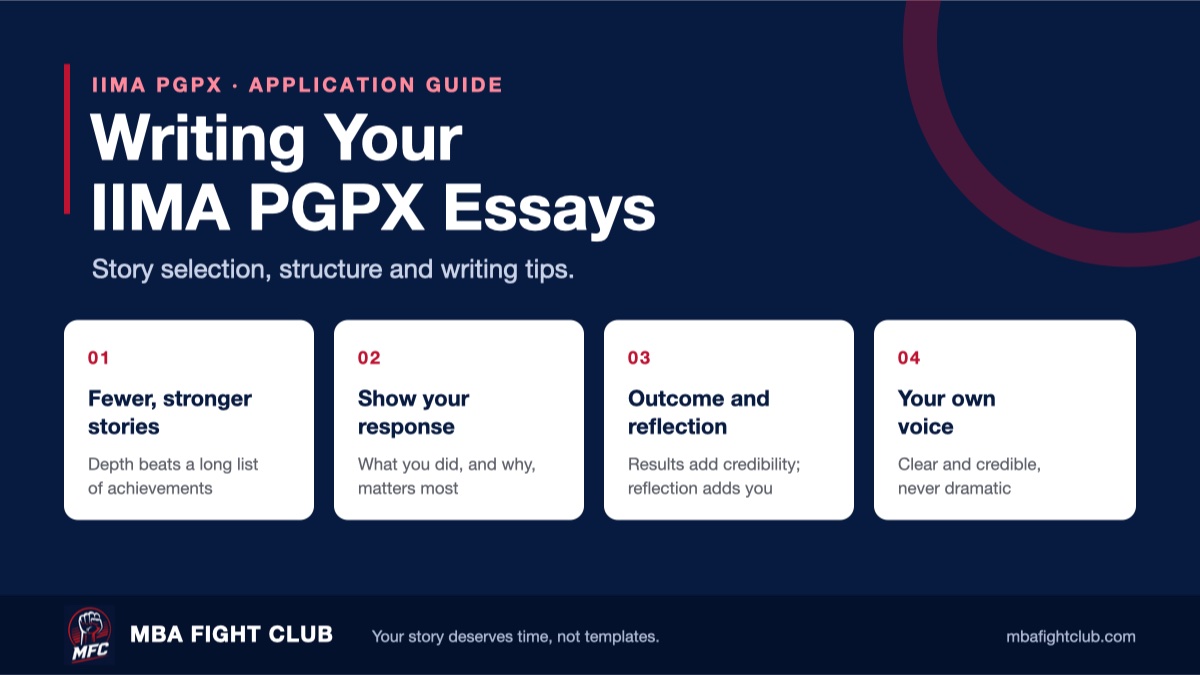
The best IIMA essays are usually not the ones with the most impressive vocabulary or the largest number of achievements. They are the ones that make it easy for the reader to understand your experiences, your choices, what you learnt from them, and what you will bring to the PGPX classroom.
Read about IIMA PGPX Extempore
Essay 1 – Challenges in your work life | 400 words
“Please describe some of the challenges you faced in your work life and how you were able to overcome them.”
This is not an essay about describing the toughest problem you have ever faced. It is about showing how you respond when things become difficult.
Your challenges can come from different situations: managing people, influencing stakeholders, solving an operational problem, dealing with uncertainty, handling resistance, working with limited resources, entering an unfamiliar role, recovering from a failure, or taking responsibility during a crisis.
Ideally, choose two strong and different challenges rather than trying to squeeze four or five examples into 400 words. Variety helps. For example, one challenge may demonstrate problem-solving under pressure while another may show stakeholder management or persistence.
For each challenge, the reader should clearly understand the situation, why it was difficult, what you did, and what happened because of your actions. Do not spend half the essay explaining the technical background. Give just enough context for someone outside your industry to follow the story.
The strongest part of the essay is often not the challenge itself but your response to it. What options did you have? Why did you choose a particular approach? Did you have to convince people? Change your original plan? Learn something quickly? Take an unpopular decision?
End the stories with outcomes and reflection. The outcome gives credibility to the story; the reflection tells IIMA what the experience says about you.
In short, the essay should answer: When faced with difficult situations, how do you think, act and learn?
Essay 2 – What makes you special? | 400 words
“Tell us what is special about you that makes you a good addition to the classroom.”
This essay is essentially asking two questions together: What differentiates you? And why should that matter to your classmates?
A common mistake is to turn this into a list of achievements: ten years of experience, international exposure, multiple awards, volunteering, hobbies and so on. All of these may be good profile points, but a list does not tell the reader what is actually special about you.
Instead, identify a central theme or combination of qualities that genuinely represents you. Your differentiator may come from an unusual career journey, the kind of problems you have worked on, your leadership style, a combination of professional and personal experiences, your exposure to different sections of society, entrepreneurship, a serious extracurricular pursuit, or even the way you approach learning and people.
Then demonstrate this through a few carefully chosen examples.
The essay can combine professional, personal and extracurricular experiences. In fact, this often makes the answer stronger because the admissions committee gets to see dimensions of you that are not visible in your resume.
But the examples should connect to each other. By the end of the essay, the reader should be able to describe you in a sentence or two.
The final part is important: explain how these experiences translate into classroom contribution. What perspective will you bring to discussions? What can peers learn from your industry, experiences, mistakes or worldview? How will you contribute beyond academics?
Do not merely say that you will “bring diverse perspectives to the classroom.” Explain what those perspectives actually are.
Essay 3 – Impact created in the last three years | 200 words
“Describe the impact you have made in your personal, professional, or social life over the past three years.”
Think of this as an achievement and impact essay, not simply an activity essay.
The keyword is impact.
IIMA is not only asking what you did. It is asking what became better because you did it.
Your example can come from professional, personal or social life. You may have transformed an important business process, launched something new, improved revenue or efficiency, built a team, helped an organisation through a difficult period, mentored people, started a venture, solved a meaningful family challenge, created a social initiative, or influenced someone's life in a significant way.
Because the essay is only 200 words, avoid spending too much space setting up the situation. Get to your role and the outcome quickly.
Wherever possible, make the impact tangible. Numbers help when they are meaningful: revenue generated, costs reduced, customers reached, turnaround time improved, people trained, adoption achieved, funds raised, scale created, or something that continued after your involvement.
But impact does not always need a number. Helping a family member through a difficult phase, changing someone's career trajectory, creating opportunities for others or building something that outlives your direct involvement can be equally meaningful.
A useful way to think about the essay is:
What changed → what did I specifically do → who benefited → how significant was the change?
Do not dilute a strong achievement by packing too many unrelated accomplishments into 200 words. One meaningful story with a clear outcome is usually more powerful than an achievement catalogue.
Reapplicant Essay | 400 words
“Tell us what has changed in your profile since the last time you applied.”
For a reapplicant, this essay should not become a defence of the previous application or an explanation of why you were not selected.
The admissions committee already knows that you applied before. The useful question is: Why are you a stronger candidate now?
Look at everything that has materially changed since your earlier application.
If your GMAT/GRE score has improved, highlight the improvement and the effort behind it. If you shifted from GMAT to GRE because it allowed you to demonstrate your academic ability better, explain that briefly rather than merely stating the new score.
Professionally, discuss promotions, expanded responsibilities, larger teams, more strategic work, new geographies, important projects or additional leadership exposure. Focus on progression rather than simply saying that another year of experience has been added.
If you started a venture or side business, took meaningful courses, developed new skills, earned certifications or deliberately worked on an area that was weak in your previous profile, these can all strengthen the story.
Also consider extracurricular and personal developments. Perhaps you became involved in a new initiative, took up a leadership responsibility outside work, dealt with a significant life experience, or gained a perspective that has changed the way you approach people or decisions.
You do not need something in every category. Include only what is genuinely true and meaningful.
The entire 400-word response should build towards one conclusion: I am applying again, but I am not the same candidate who applied last time. I now have more experience, stronger capabilities and more to contribute to the PGPX cohort.
A few principles that apply to all three essays
With a 400-word limit for most essays and only 200 words for the third, every paragraph should earn its place.
Keep the language simple. An MBA essay is not a test of difficult vocabulary. It is a test of clarity, self-awareness and judgement.
Use examples instead of adjectives. Instead of calling yourself resilient, collaborative or entrepreneurial, tell a story that makes the reader reach that conclusion.
Separate your contribution from the team's contribution. Senior professionals naturally work through teams, but the admissions committee still needs to understand what you personally influenced or decided.
Do not make all three essays repeat the same achievement. Together, the essays should reveal different parts of your profile.
And most importantly, make sure the essays still sound like you. A polished essay that could have been written for fifty other applicants is far less useful than a simple, specific story that only you could tell.
IIMA PGPX Essay Review – Limited Slots
In the previous IIMA PGPX cycle, 4 out of the 5 candidates we worked with qualified IIMA:
Ishita Rastogi | Chris Vincent | Amit Soni | Ria Rajpopat
Ria subsequently chose not to join the programme.
IIMA PGPX essay reviews are available individually or as part of our full plans. See current plans and fees, or build your own package.
Your IIMA essays do not need to make you sound extraordinary.
They need to make the admissions committee understand, clearly and credibly, what you have done, how you think, what impact you have created, and why having you in the PGPX classroom will make the cohort better.
MBA Fight Club
Because your story deserves time — not templates.
Read about IIMA PGPX Extempore
Want this applied to your own profile?
Book a free 40-minute discussion with Abhinav. Talk through your score, experience and target programmes, and what your application needs. Only 10 applicants are taken each round.
Chat on WhatsApp See plans & fees