The ISB Post Graduate Programme (PGP) is more than an MBA. It’s an intense, transformative experience — and your essays are the bridge between your story and ISB’s vision.
The essays help the admissions committee see who you are beyond scores and job titles.
As ISB says, your essays should complement your application and reflect your authentic self.
Let’s break down each essay, understand what ISB is looking for, and how you can craft a compelling story that works.
The prompts below match ISB's official requirements page for the PGP Class of 2028 cycle: two mandatory 400-word essays and one optional 250-word essay. Reapplicants also write a separate reapplicant essay. Round 2 closes on 6 December 2026 and Round 3 on 17 January 2027. Always check the live application portal before you submit.
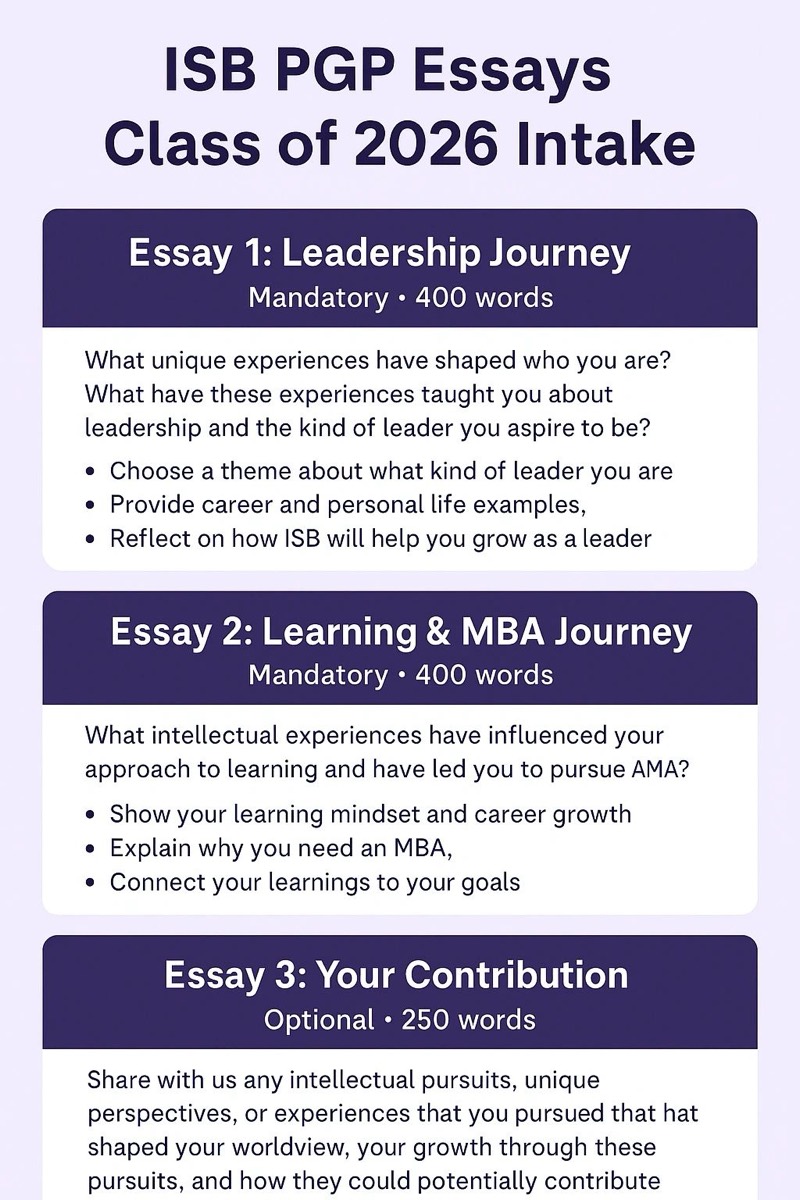
Essay 1 – Leadership Journey (Mandatory, 400 words)
“What unique experiences have shaped who you are? What have these experiences taught you about leadership and the kind of leader you aspire to be?”
This essay is your chance to answer “Who am I as a leader?”
What ISB Expects:
- A clear theme about your leadership style — empathetic, transformational, result-oriented, collaborative, or strategic.
- Examples that demonstrate your leadership in action — ideally one from work, but you can include a personal example if it shaped your approach deeply.
- Reflection on what you’ve learned and how you aspire to evolve as a leader at ISB.
How to Structure It:
- Start with a theme:
Open with a single line that defines your leadership identity.
E.g., “I’ve always believed leadership is less about authority and more about accountability.” - Show, don’t tell:
Back your theme with specific examples. Choose an incident that highlights your initiative, problem-solving, or ability to influence without authority.
E.g., leading a cross-functional project, driving change during crisis, or mentoring a team. - Reflect and connect:
Conclude by linking what you’ve learned from these experiences to the kind of leader you want to become — and how ISB will help you get there.
E.g., “While my experience taught me how to manage people, ISB’s focus on experiential learning will strengthen my ability to lead across cultures.”
Writing Tips:
- Avoid listing achievements — tell one or two stories deeply.
- Be authentic; ISB values clarity and sincerity over grand claims.
- Keep it simple — the reader should instantly grasp your core message.
Essay 2 – The Learning & MBA Journey (Mandatory, 400 words)
“What intellectual experiences have influenced your approach to learning and have led you to pursue an MBA? Please describe using anecdotes from your own experiences.”
This is essentially your ‘Why MBA?’ essay — but through a reflective lens.
What ISB Expects:
- Evidence of a growth mindset — your approach to learning, adapting, and self-improvement.
- Trigger points that led you to pursue an MBA — perhaps you hit a ceiling in your current role or discovered a gap in business knowledge.
- A logical link between your experiences, your learning needs, and how ISB fits into your career journey.
How to Structure It:
- Start with a learning mindset:
“Throughout my career, I’ve learned most when stepping outside my comfort zone.” - Show your intellectual growth:
Talk about key experiences that shaped how you learn — a project, a failure, a global collaboration, or a major career pivot. - Explain the need for an MBA:
Highlight what gaps you’ve identified in your knowledge — strategy, finance, leadership, or cross-functional thinking — and how these gaps are holding back your growth. - Connect with ISB:
Show how ISB specifically fills these gaps — mention courses, peer learning, or its strong industry interface.
E.g., “ISB’s strong focus on data-driven decision-making through its Applied Business Research Lab directly aligns with my goal to transition into product strategy.”
Writing Tips:
- Make the essay forward-looking, not just a recap of the past.
- It’s okay to mention your career goals if they fit naturally into the flow.
- Keep the tone humble but purposeful — show awareness of what you know and what you need to learn.
Essay 3 – The Optional Essay (250 words)
“Share with us any intellectual pursuits, unique perspectives, or experiences that you pursued that have shaped your worldview. How could they potentially contribute to our learning community?”
Should you write it?
Yes, absolutely. It’s optional, but not writing it means missing a chance to stand out.
What ISB Expects:
- Your unique contribution — what makes you a valuable addition to the ISB classroom.
- What perspective, skill, or experience you bring that can enrich your peers’ learning.
How to Structure It:
- Start with your USP:
“Coming from a decade in the energy sector, I’ve learned how policy, sustainability, and innovation intersect.” - Show how it shaped you:
Talk about what this pursuit or experience taught you — teamwork, resilience, empathy, creativity, etc. - End with contribution:
Tie it back to ISB — how your experience can help peers, faculty, or student clubs.
E.g., “At ISB, I look forward to bringing this perspective to sustainability discussions in the Business Technology Club.”
Writing Tips:
- Use this space to show what’s not visible elsewhere in your application.
- Don’t repeat content from the previous essays.
- Keep it crisp and reflective.
General Writing Guidelines
- Stick to the word limit. 400 and 250 words mean you must be concise — clarity over complexity.
- Maintain one core message per essay. If your essay can describe someone else, it’s not personal enough.
- Use simple language. You don’t need flowery vocabulary — just authenticity and coherence.
- Storytelling works. A chronological or thematic story makes your essay memorable.
- Reflect, don’t report. Avoid turning essays into resumes — focus on meaning and insight.
- AI can assist, not replace. You may use tools for grammar or structure, but ensure the content is 100% your own.
Final Thoughts
The ISB essays are your opportunity to connect your past, present, and future in one narrative. They should tell a story that only you can tell — a story of growth, purpose, and potential.
Take your time. Reflect deeply. Write honestly.
And remember ISB’s golden rule:
“If your essay could describe someone else, take another pass.”
Preparation Support
ISB essay reviews are available individually or as part of our full plans. See current plans and fees, or build your own package.
Want this applied to your own profile?
Book a free 40-minute discussion with Abhinav. Talk through your score, experience and target programmes, and what your application needs. Only 10 applicants are taken each round.
Chat on WhatsApp See plans & fees